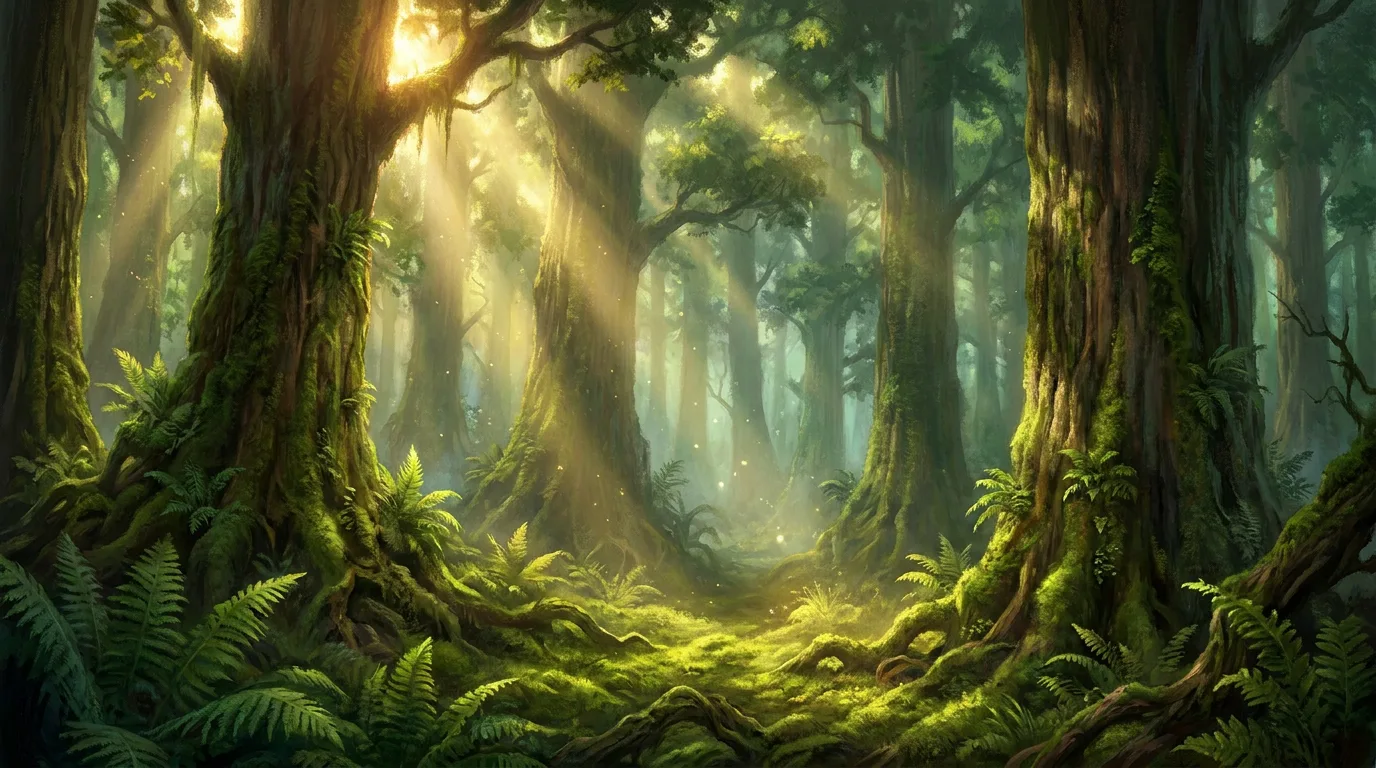
How forests and woods get their names
A forest name has to do two things at once: sound like a real place on a map and hint at the kind of story that happens under its canopy. The strongest woodland names manage both in a single fused word. This generator is built around that compound form first, then rounds it out with the longer shapes and an optional one-line legend, so a batch gives you both quick map labels and the seed of a story.
The compound woodland word
The signature shape here is one evocative prefix fused straight onto a woodform: Whisper joined to wood becomes Whisperwood, Thorn joined to hollow becomes Thornhollow, Dusk joined to thicket becomes Duskthicket. The woodforms, wood, wald, hollow, thicket, shaw, holt, coppice, and grove, are the same endings English place names have used for centuries, which is exactly why the results feel old rather than made up on the spot. A compound name is also compact enough to sit on a map without crowding it, and it reads as a proper noun immediately, no article or preposition required. Most batches from this tool lean on the compound form, because it is the one that does the most work for the fewest syllables.
Choosing a character, and why legends split by tone
The character selector does more than swap a few words: it changes the whole palette. An enchanted forest draws on luminous, fae-touched prefixes and wonder-toned legends, the kind where lost travelers are led gently back to the road. A dark forest draws on grim prefixes and a strictly separate pool of dread legends, the kind where no hunter comes back the same. Ancient, verdant, autumnal, and frostbound each shift the palette again, toward old-growth stone, lush green, amber and copper, or rime and snow. Keeping the legend pools separate by tone is deliberate: a forest your heroes are warned about should never accidentally promise them a blessing, and a fairy-tale wood should never read like a trap.
Consistency across a map
The quickest way to break a map's spell is to let every woodland sound like it was named by a different hand. Keep two things steady. First, pick one character for one region and generate several batches in it, so neighboring woods share a mood the way neighboring real forests share a climate. Second, match the woodland type to the feature: reserve grove for the small sacred cluster, thicket for the tangle your travelers have to fight through, and the wilds for the trackless country nobody has mapped. When you need the peaks above the treeline, the mountain name generator works at that scale; for the water running through the trees, the river name generator handles it; and the kingdom name generator names the realm that holds them all. Everything generated here is free to use in personal and commercial projects alike.